
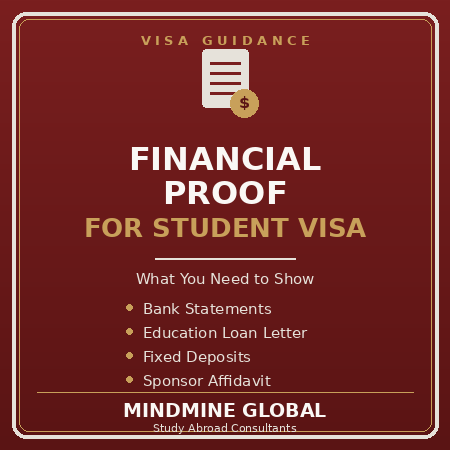
Planning to study abroad involves more than getting admission to a university and securing an offer letter. When applying for a student visa, one of the most important things students need to demonstrate is that they have enough money to support their education and stay in the destination country. This is where Financial Proof for Student Visa becomes important.
Visa authorities want to know whether you can realistically pay for your tuition fees, accommodation, living expenses, travel and other necessary costs without facing financial difficulties during your studies.
The exact amount and type of financial evidence required depend on the country, course, university, duration of study and your individual circumstances. Canada, the UK, Australia and other popular study destinations have their own rules regarding acceptable funds and supporting documents. These requirements can also change, so students should always check the latest information from the relevant immigration authority before submitting an application.
For Indian students planning to study abroad, preparing financial documents early can make the visa process more organised and reduce the chances of delays caused by incomplete or inconsistent information.
What Is Financial Proof for a Student Visa?
Financial proof is documentation that shows you have sufficient funds to pay for your education and living expenses while studying abroad. Depending on the destination, the money may come from your personal savings, parents, a financial sponsor, an education loan, scholarship or another permitted source.
The purpose is not simply to show a large amount of money in a bank account. Visa officers may also look at where the money came from, whether the funds are genuinely available to you and whether your overall financial situation makes sense.
For example, if a student’s bank account suddenly receives a very large deposit shortly before the visa application, the applicant may need to explain the source of those funds. Clear documentation makes it easier to establish that the money is legitimate and available for education-related expenses.
Why Is Financial Proof Important for a Student Visa?
Financial proof helps visa authorities understand whether students have sufficient funds to support their education and living expenses abroad. It also provides context for the overall visa application by showing how tuition fees, accommodation, daily costs and other study-related expenses will be managed.
- It Shows You Can Afford Your Education: Studying overseas can involve significant expenses, including tuition fees, accommodation, food, transportation, health insurance and other personal costs. Financial documents help demonstrate that these expenses can be managed without depending entirely on employment after arrival.
- It Supports the Credibility of Your Application: A well-organised financial profile can strengthen the overall visa application. Your academic documents, admission letter, study plans and financial evidence should tell a consistent story about your plans to study abroad.
- It Helps the Visa Officer Assess Your Financial Situation: Visa authorities may assess whether you have genuine access to the money required for your studies. This is why simply showing property ownership or assets may not always be enough. Depending on the country, liquid funds, bank statements, loans, scholarships and sponsor documents may be more relevant.
How Much Financial Proof Is Required for a Student Visa?
There is no single financial amount that applies to every student visa application. The requirement depends on the destination country and your specific circumstances.
Students generally need to account for some or all of the following:
- Tuition fees
- Accommodation expenses
- Daily living costs
- Health insurance
- Travel expenses
- Dependants’ expenses, if applicable
- Other mandatory costs associated with the visa or course
For example, Canada requires students to demonstrate funds for tuition, living expenses and transportation. From applications made on or after September 1, 2026, the published living-expense amount for one student outside Quebec is CAD 23,448 per year, excluding tuition and transportation.
The UK currently requires students to show money for their course fees as well as living costs. For courses in London, the current maintenance requirement is £1,529 per month for up to nine months, while students studying outside London need £1,171 per month for up to nine months.
Australia may require evidence covering travel costs, 12 months of living expenses, tuition fees and certain school costs for accompanying dependents when financial evidence is required.
These figures demonstrate why students should avoid relying on generic financial requirements found on old websites or social media posts.
Documents Commonly Used as Financial Proof for Student Visa
Students can use different types of financial documents to demonstrate their ability to fund their education. The right documents may vary depending on the visa requirements, funding source and financial circumstances of the applicant.
Bank Statements
Bank statements are among the most commonly used documents for demonstrating available funds. They can show your savings or the funds held by your parents or financial sponsor.
The statements should be clear, authentic and consistent with the information provided in the rest of your application. Depending on the destination and visa office, statements covering several months may be required.
Students should avoid making unexplained large deposits shortly before applying. If there are significant recent transactions, keep documents ready to explain their source.
Education Loan Documents
An approved education loan can be an important source of financial support for international education. Students may provide loan sanction letters or other documents issued by the lending institution, depending on the country’s requirements.
The loan should clearly indicate the approved amount and relevant details. If tuition fees have already been paid using the loan or another source, proof of payment can also be useful.
Canada, for example, lists proof of a student or education loan from a bank among the documents that may be used to demonstrate financial capacity.
Scholarship or Sponsorship Letter
Students who have received scholarships can use official scholarship documentation as part of their financial evidence.
The letter should clearly state the amount or type of support provided and, where relevant, the period for which the scholarship applies. If the scholarship only covers tuition, students may still need to show separate funds for living expenses and transportation.
Similarly, students financially supported by an organisation, institution or another eligible sponsor may need documentation confirming the sponsorship.
Sponsor’s Income Documents
Many international students are financially supported by their parents or close family members. In such cases, it can be useful to provide documents that establish the sponsor’s ability to fund the student’s education.
Depending on the visa rules, these may include:
- Salary slips
- Employment letters
- Income tax documents
- Bank statements
- Business income documents
- Investment records
- Other evidence of regular income
Canada’s current guidance, for example, lists employment documents, pay stubs and documents establishing the relationship between the student and the person providing financial support among possible evidence.
Tuition Fee Payment Receipt
If you have already paid part or all of your tuition fees, keep the official payment receipt. This can demonstrate that a portion of your educational expenses has already been covered.
However, paying tuition does not necessarily mean that no additional financial evidence is required. You may still need to demonstrate sufficient funds for living expenses, transportation and any remaining costs.
Fixed Deposits and Other Financial Assets
Depending on the country and visa rules, students may be able to provide evidence of certain deposits, investments or other financial resources.
However, students should not assume that every asset will automatically be accepted as proof of available funds. Property, jewellery, shares or other assets may demonstrate overall financial strength but may not be treated in the same way as readily accessible funds.
Always check which forms of financial evidence are accepted for your specific visa category.
Can Parents’ Bank Statements Be Used for a Student Visa?
In many cases, parents can financially support a student’s overseas education. However, simply submitting a parent’s bank statement may not be sufficient on its own.
The application may need to establish:
- Who owns the account
- The relationship between the student and sponsor
- Where the money came from
- The sponsor’s source of income
- Whether the sponsor can realistically provide the stated amount
- Whether the funds are available for the student’s education
The exact requirements vary by destination. Students should therefore prepare financial documents according to the rules of the country where they are applying.
How to Show Financial Proof for a Student Visa
Showing financial proof clearly can make the visa documentation process easier to manage. Students should organise their financial records carefully and ensure that all documents clearly support their ability to fund their studies.
Start Preparing Your Documents Early
Financial documentation should not be treated as a last-minute task. Start reviewing your finances as soon as you receive your admission offer or begin preparing for the visa application.
This gives you enough time to arrange education loans, collect income documents, organise bank statements and resolve inconsistencies before submitting the application.
Maintain a Clear Financial History
A stable and understandable financial history is generally easier to explain than a bank account containing several unexplained transactions.
If you are planning to use savings for your education, maintain proper records of those funds. If money has been transferred from another account or received through the sale of an asset, keep supporting documents that explain the transaction.
Keep Supporting Documents Together
Do not submit a bank statement without considering the documents that establish the source of the funds.
For example, if your education is being funded by your parents, your financial file may include bank statements along with employment or income documents and evidence of your relationship with the sponsor.
Make Sure the Information Is Consistent
The figures mentioned across your application should make sense together. Tuition fees, funds available, education loans, scholarships and sponsor income should not contradict one another.
Even a genuine financial situation can appear confusing if the documents are poorly organised or contain conflicting information.
Common Mistakes Students Make With Financial Proof
- Showing Insufficient Funds: One of the most obvious problems is not having enough evidence to cover the expenses required by the destination country. Students should calculate tuition, living costs, travel and other applicable expenses before preparing their financial file.
- Unexplained Large Deposits: A sudden large credit in a bank account can raise questions about the source of funds. If such a transaction is genuine, supporting evidence should be available.
- Using Outdated Financial Information: Financial requirements can change, and some countries specify how recent financial documents need to be. Students should use current documents and check the latest requirements before applying.
- Depending Only on Property or Assets: Owning a house, land or other assets does not necessarily mean that you have immediately available funds for your education. Students should understand the difference between total wealth and accessible financial resources.
- Providing Incomplete Sponsor Documents: If parents or another sponsor are paying for your education, their financial position should be properly documented. Missing income evidence or unclear relationships can make the financial picture difficult to understand.
- Ignoring Country-Specific Rules: Financial proof for a UK student visa is not the same as financial proof for a Canadian study permit or Australian student visa. Each country has its own rules, acceptable evidence and financial calculations.
Financial Proof for Popular Study Destinations
Financial requirements vary by country, so students should understand the documents, funds and financial evidence needed for their chosen study destination.
Financial Proof for Canada Student Visa
Canada requires students to show they can pay their tuition, living expenses and transportation without relying on work in Canada. Students applying for programs longer than one year also need to explain how they plan to finance the full duration of their studies. Acceptable evidence can include bank statements, education loans, scholarships, tuition payment receipts and sponsor-related financial documents.
Financial Proof for UK Student Visa
For the UK, students generally need to show money for tuition fees stated on their CAS and the required living expenses. Where financial evidence is required, the money must meet specific holding and documentation rules. The UK currently requires qualifying funds to have been held for a continuous 28-day period, with the closing date of that period falling within the permitted timeframe before the application.
Financial Proof for Australia Student Visa
Australia may require students to provide evidence covering travel costs, living expenses, tuition and applicable costs for accompanying family members. Evidence may include deposits with financial institutions, loans, scholarships or financial support. The Department of Home Affairs also makes clear that students should provide financial capacity evidence when their document checklist requires it.
Financial Proof for USA Student Visa
For students applying to study in the USA, financial preparedness can also form an important part of the visa process. Students should be prepared to explain how they will fund tuition and living expenses and provide relevant financial documentation if requested during the visa process.
Because requirements and supporting evidence can depend on the institution and individual application, students should follow the instructions provided by their university and the US Embassy or Consulate handling their application.
How Can Students Make Their Financial File Stronger?
A strong financial file is not necessarily the one with the highest bank balance. It is the one that clearly explains how the student’s education will be funded.
Before submitting your application, check whether:
- Your available funds meet the current requirement.
- Your bank statements are recent and complete.
- Large transactions can be explained.
- Your sponsor’s income is supported by documents.
- Education loan documents are official and complete.
- Scholarship details are clearly mentioned.
- Tuition payments have supporting receipts.
- Your documents consistently reflect the same financial information.
- You have checked the latest requirements for your destination country.
Final Checklist for Financial Proof for Student Visa
Before submitting your student visa application, keep a checklist of the financial documents relevant to your situation:
- Recent bank statements
- Education loan sanction or approval documents, if applicable
- Scholarship or sponsorship letter, if applicable
- Sponsor’s employment and income documents
- Salary slips or business income documents
- Income tax-related documents, where relevant
- Tuition fee payment receipt
- Fixed deposit or other permitted financial evidence
- Proof of relationship with your financial sponsor
- Explanation and supporting documents for significant transactions
The exact list will depend on your destination and personal circumstances, so this checklist should be treated as a starting point rather than a universal visa requirement.
Conclusion
Financial proof for a student visa is more than showing money in a bank account. It is about demonstrating that you have a genuine, reliable and properly documented plan to finance your education and living expenses abroad.
Students should begin preparing their financial documents well before the visa application, maintain clear records and make sure the source of funds can be explained. Bank statements, education loans, scholarships, sponsor income and tuition payment receipts can all play a role depending on the destination and individual circumstances.
Most importantly, do not rely on old financial figures or generic advice. Visa requirements can change, and the amount or type of evidence accepted by one country may not be accepted by another.
If you are planning to study abroad and are unsure about your financial documents, visa requirements or overall application process, professional guidance can help you organise the process more carefully. Mindmine Global provides study abroad counselling and student visa assistance to help students understand documentation, university requirements and the steps involved in planning their international education.
Read Also This Blog
Study Abroad Intake 2027: Complete Guide to Admission Intakes