
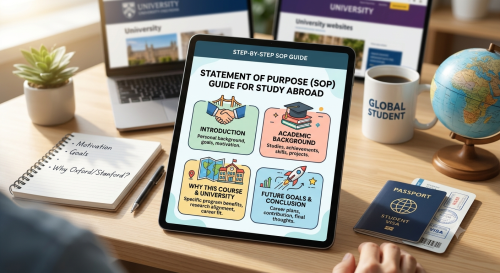
Every year, thousands of students from India apply to universities in Canada, the UK, Australia, New Zealand, the USA and Europe. Most of them have good marks and a valid IELTS, PTE or TOEFL score. However, a well-written Statement of Purpose (SOP) can make their application stand out. Understanding how to write an effective SOP for study abroad with sample can help students present their academic background, motivation and future goals clearly.
If you are wondering how to write an SOP that actually gets noticed, this guide is for you. We will cover what an SOP is, what to include, how to write it step by step, and a sample SOP to show how it all comes together.
What Is an SOP for Study Abroad?
A Statement of Purpose is a personal essay that you submit along with your university application. It explains who you are, what you have done so far, why you want to study a particular course, and what you plan to do after graduation.
Think of it as your chance to speak directly to the admissions committee. Your transcripts show your grades. Your SOP shows your thinking, your motivation and your plans. Some universities call it a Personal Statement or Letter of Motivation, but the purpose is the same.
Most universities expect an SOP of about 500 to 1,000 words, but always check the exact limit on the application portal.
Why Is the SOP So Important?
Admissions officers read hundreds of applications. Many students have similar marks and similar test scores. A well-written SOP helps the committee see you as a real person with a clear direction.
A strong SOP shows that:
- You have clear academic and career goals
- You have chosen the course and country for genuine reasons
- You can express yourself in clear English
- You are likely to succeed and complete the programme
It also matters for your student visa. A visa officer may compare your SOP with your documents and your answers in an interview, so your story has to be consistent and honest.
What Should an SOP Include?
A good SOP follows a logical flow. You do not need fancy language, but you do need a clear structure.
- A strong introduction. Begin with a specific moment, experience or question that sparked your interest in the subject. Avoid generic openings like “I have always been passionate about technology.” A short, real story is far more memorable.
- Your academic background. Mention your degree, the subjects you did well in, and any projects or research that relate to your chosen course. Focus on what is relevant, not everything you have ever studied.
- Work experience and activities. Include internships, jobs, certifications, volunteering or competitions that connect with your goals. If you have little work experience, projects and online courses count too.
- Why this course. Explain what draws you to the subject and what skills you want to gain. This is where you show you have read the curriculum and understand what the programme offers.
- Why this country and university. Be specific. Mention modules, faculty, research areas, work placement options or facilities. A reason like “it is a good country” is too weak. Explain what that country’s education system offers that fits your goals.
- Career goals. Share your short-term and long-term plans. Short-term might be gaining industry experience after your course. Long-term might be starting a business or returning to India to apply your skills. Make sure your plans sound realistic.
- A confident conclusion. Close by tying your background, your chosen course and your goals together in a few sentences.
How to Write Your SOP Step by Step
- Start by reading the instructions. Each university may have a different word limit, format or set of questions. Following them carefully is the first test of your application.
- Make a list before you write. Note down your key subjects, projects, work experience, achievements and the moment you became interested in your field. This gives you raw material to choose from.
- Research the course properly. Go through the university website and pick two or three specific things you like about the programme. These details make your SOP feel personal instead of copied.
- Write a rough draft first. Do not worry about perfect sentences. Get your story on paper, then reorganise and improve it.
- Edit with a critical eye. Cut repetition, remove vague phrases and replace big claims with real examples and numbers. Read the SOP aloud to catch awkward sentences.
- Get feedback. Ask a teacher, mentor or study abroad counsellor to review your draft. A fresh pair of eyes will spot gaps you cannot see yourself.
- SOP for study abroad with sample
The sample below is fictional and is meant only to show structure and tone. Please do not copy it. Universities use similarity checks, and your SOP must reflect your own story.
Course applied for: Postgraduate Diploma in Data Analytics, Canada
During the final year of my B.Com, I helped my uncle’s textile shop in Delhi move its sales records from paper registers to a spreadsheet. Within a month we found that three products made up most of the profit, while two others were quietly losing money. That small discovery changed how I thought about numbers, and it is the reason I want to build a career in data analytics.
I completed my B.Com in 2024 from a university in Delhi with 71 percent. Statistics and Business Mathematics were my strongest subjects, and I scored above 80 percent in both. In my final semester I worked on a project that studied customer buying patterns for a local retail store, using Excel and basic charts. The project taught me that I enjoyed the analysis more than the accounting, but I also saw the limits of my tools.
To close that gap, I completed an online course in SQL and Power BI and worked for ten months as a junior data entry and reporting executive at a distribution company. There I built weekly sales dashboards that reduced the time my manager spent on reports from two hours to thirty minutes. I now want formal training so I can move from reporting what happened to explaining why it happened.
I have chosen the Postgraduate Diploma in Data Analytics because its curriculum combines statistics, database management, data visualisation and a work placement. These are exactly the skills I am missing. I am particularly interested in the course’s applied projects with industry partners, because I learn best by working on real business problems.
I chose Canada because of its strong technology and finance sectors, its focus on practical, career-oriented education, and its welcoming environment for international students. The college’s small class sizes and career services also fit the hands-on support I need as a first-time student abroad.
After completing the course, I plan to work as a data analyst in Canada for a few years to gain industry experience. In the long term, I want to return to India and help small and mid-sized businesses, like my uncle’s shop, use their data to make better decisions. Writing a clear SOP for study abroad with sample has helped me understand how to present my academic goals and future plans effectively. I am confident that this programme will give me the knowledge and discipline to achieve that goal. I thank the admissions committee for considering my application.
Why This Sample Works
It opens with a real, specific moment instead of a cliché. Each paragraph has a clear purpose and flows into the next. It uses numbers (71 percent, two hours to thirty minutes) rather than empty claims. The reasons for choosing the course and country are specific, and the career plan is realistic, with a clear reason to return home.
Common SOP Mistakes to Avoid
- Copying a template. Copied SOPs are easy to detect and can lead to rejection. Use samples only to understand the structure.
- Telling your whole life story. Keep only what supports your choice of course.
- Being vague. A line such as “I want to gain global exposure” does not say much. Explain exactly what you want to learn and why.
- Hiding a study gap. If you have a gap in your studies or a dip in marks, explain it briefly and honestly, and show what you did during that time.
- Exaggerating. Everything in your SOP should match your documents and hold up in a visa interview.
- Sending one SOP everywhere. Update the course, university and country details for every application.
- Skipping proofreading. Spelling and grammar errors can make a good story look careless.
Quick SOP Checklist Before You Submit
Before you hit submit, make sure your SOP stays within the word limit, opens with a genuine hook, clearly explains your background, names specific reasons for your course, university and country, states realistic career goals, matches your CV and transcripts, and has been proofread by someone else.
Ferquently Asked Questions
Q1: How long should an SOP be?
Most universities expect 500 to 1,000 words. Always follow the limit given in the application portal.
Q2: Is an SOP the same as a personal statement?
They are very close. An SOP usually focuses more on your academic and career plans, while a personal statement can be a bit more personal. Follow the term each university uses.
Q3: Can I use the same SOP for different countries?
Keep your core story, but rewrite the course, university and country sections every time. Visa requirements also differ between countries, so check each one.
Q4: Should I explain a study gap?
Yes, briefly and honestly. Say what you did during the gap, such as work, a course or family responsibilities, and show you are ready to return to study.
Q5: Can a consultant write my SOP for me?
A good counsellor guides you, reviews your drafts and helps you improve structure and clarity. The ideas and experience must be your own.
Final Thoughts
Your SOP is your opportunity to turn a set of marks and documents into a story that an admissions officer remembers. Whether you are preparing an SOP for study abroad with sample or writing your own from scratch, be honest, be specific, and show clearly how your past connects to your future goals. With a little planning and a few rounds of editing, you can write an SOP that makes your study abroad application stand out.
Need Help With Your Study Abroad Application?
Writing about yourself is harder than it looks, and a small change in structure can make a big difference. Mindmine Global, a division of Mindmine Academy, offers professional counselling and mentoring for students applying to Canada, the UK, Australia, New Zealand, Europe, the USA and Dubai. The team can help you shortlist universities, understand intakes and deadlines, and prepare your documents, along with IELTS, PTE and TOEFL coaching.
Book your free counselling session today.
Call: +91-9810953973
Visit: 1st Floor, B4, B Block Community Centre, Janakpuri, Delhi 110058
Read Also This Blog