
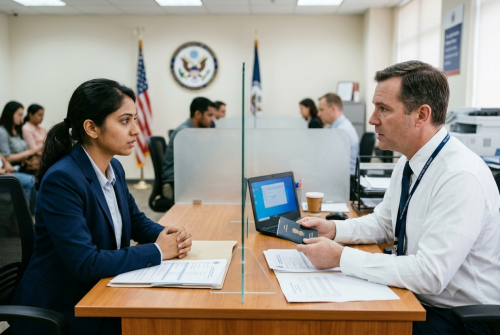
You have your offer letter, your IELTS or PTE score and your financial documents ready. The last big step before you fly is the student visa interview. For many students it is the most nerve-racking part of the whole process, but it does not have to be.
Visa officers are not trying to trick you. They want to confirm that you are a genuine student, that you can pay for your studies, and that you have a clear plan. In this guide, we will look at why the interview matters, which countries conduct one, the most common student visa interview questions with sample answers, and how to prepare so you walk in with confidence.
Why Does the Visa Interview Matter?
Before we get to the questions, it helps to understand what the officer is actually looking for, because every question you are asked connects back to it.
Even with a perfect application, the interview is where the officer decides whether your story is believable and consistent. The interview is usually short, sometimes only a few minutes, so every answer counts.
In simple terms, the officer is checking three things:
- Genuine intent: Are you really going to study, and do you understand your course?
- Financial ability: Can you or your sponsor pay tuition and living costs?
- Ties and future plans: Do you have a clear plan for after your studies?
Keep these three points in mind as you read on, because each group of questions below tests one of them.
Which Countries Interview Students?
Not every country runs its visa process the same way, so it is important to know what to expect for your destination before you start preparing.
USA: The F-1 visa interview at the US Embassy or Consulate is one of the most well-known parts of the student visa process. During the interview, officers may ask various student visa interview questions about your chosen course, university, financial arrangements and future plans. All F, M and J applicants must now attend an in-person interview, as the waiver option is no longer available for most students. Social media screening also applies. Always confirm the latest rules on the official US government travel site before your appointment.
UK: Some students are called for a credibility interview with the Home Office, usually online, to test their understanding of the course and their intentions.
Canada and Australia: An interview is not always required, but you may be asked to attend one. Australia’s Genuine Student requirement is assessed mainly through your written responses, and officers may ask follow-up questions.
Whichever country you choose, the core questions are very similar, so let us go through them one group at a time.
Common Student Visa Interview Questions and Sample Answers
Below are the questions students are asked most often, grouped by topic so you can prepare section by section. The sample answers are only examples. Use your own facts and speak naturally, because memorised, word-for-word answers sound rehearsed and can raise doubts.
1. Study Plan Questions
These questions test your genuine intent. The officer wants to see that you chose your course and university for real reasons, not just because someone suggested them.
Why do you want to study this course?
Give a clear, specific reason that links your background to your goals.
Sample: “I completed my B.Com and worked in reporting for ten months. I enjoyed analysing sales data, and this course gives me the formal training in statistics and databases that I am missing.”
Why did you choose this university?
Mention two or three specific things, such as modules, faculty, work placement options or facilities.
Why this country and not India or another country?
Explain what the education system there offers that fits your goals, such as practical learning, industry links or a specialised course.
What will you study in your first semester?
Know your core modules. This is a common question to test whether you have read your own course structure.
Once the officer is satisfied with your study plan, the conversation usually moves to your education so far.
2. Academic Background Questions
Here the officer checks that your past studies and your new course make sense together, and that your academic story has no unexplained jumps.
Tell me about your previous education.
Give a short summary of your degree, marks and key subjects.
Why is there a gap in your studies?
Be honest and brief, and say what you did during the gap, such as work, a course or family responsibility.
Why are you changing your field?
Show a logical link, like a project, job or course that moved you towards the new subject.
After your academic profile, the next topic is almost always money.
3. Financial Questions
These questions test your financial ability. Officers want to be sure your studies and living costs are properly funded, and that the funds come from a genuine source.
Who is sponsoring your studies?
Name your sponsor and their relationship to you clearly.
What does your sponsor do, and what is their annual income?
Know the answer without checking your papers. It should match your financial documents exactly.
How much will your course cost, and how will you pay?
Know your tuition fee, estimated living costs and how the funds are arranged, including any education loan.
With your funding clear, the final group of questions looks ahead to what you plan to do after you graduate.
4. Career and Future Plan Questions
This group tests your ties and future plans. The officer wants to see a realistic path after your course, not just a plan to get abroad.
What are your plans after completing your course?
Share a realistic short-term and long-term plan.
Sample: “I would like to gain industry experience in my field and later use those skills in India, where I want to help small businesses use data.”
Do you plan to return to India?
Answer honestly. Show that you have family, career or business reasons connecting you to home, especially for countries where this is assessed.
Do you have relatives in the country?
Be truthful. A mismatch with your forms can be more damaging than the answer itself.
Knowing the questions is only half the job. The other half is how you prepare, so let us look at some practical tips.
Tips to Prepare for Your Student Visa Interview
Good preparation turns nervousness into confidence. These six habits will help you give clear, consistent answers on the day.
- Know your application inside out. Re-read your SOP, application form, offer letter and financial documents. Everything you say must match what is on paper.
- Practise aloud. Do a mock interview with a counsellor, teacher or friend. Practise speaking clearly and keeping answers short.
- Keep answers short and direct. Answer the question that was asked and then stop. Long, rambling answers create more chances for errors.
- Carry your documents in order. Keep your passport, offer letter, financial proof, academic documents and test scores in a neat folder.
- Dress neatly and stay calm. You do not need formal clothes, but a clean, simple outfit shows you take the interview seriously. If you do not understand a question, politely ask the officer to repeat it.
- Be honest. If you do not know something, say so. A genuine answer is always better than a made-up one.
Preparing well also means knowing what to avoid, because a few small mistakes can undo a lot of good work.
Common Mistakes to Avoid
Many refusals are caused by mistakes that are easy to fix. Watch out for these six before your interview date.
- Memorising answers. Officers can tell when answers sound scripted.
- Giving different answers from your documents. Inconsistency is one of the biggest causes of refusal.
- Not knowing your sponsor’s details. If your sponsor pays, you should know their occupation and income.
- Being unsure about your course. If you cannot explain your modules, the officer may doubt your intent.
- Showing weak ties to home. Be ready to explain your plans after graduation clearly and honestly.
- Arguing with the officer. Stay polite and calm, even if a question feels difficult.
If you are still wondering about a few details, the answers to the most common doubts are below.
Frequently Asked Questions
Here are quick answers to the questions students ask us most often before their interview.
Q1: How long does a student visa interview take?
It can be very short, from a few minutes to around fifteen, depending on the country and the case.
Q2: What documents should I carry?
Your passport, offer or admission letter, financial documents, academic transcripts, test scores and the visa appointment confirmation. Check the official list for your country.
Q3: What if I do not speak fluent English?
You do not need perfect English, but you should be able to explain your plans clearly. Language test preparation such as IELTS, PTE or TOEFL helps build this confidence.
Q4: What should I do if my visa is refused?
Ask for the reason for refusal, understand what went wrong and speak to a counsellor before reapplying. Do not rush back with the same application.
Final Thoughts
To bring everything together, student visa interview questions are not about testing your perfection but understanding your intentions as a student. It is important to be clear, honest and consistent in your answers. If you understand your course, can explain your finances and have a realistic plan for your future, you are already well prepared. Practise a few times, stay calm, and let your genuine story do the work.
Need Help Preparing for Your Visa Interview?
If you need expert support in preparing for student visa interview questions, Mindmine Global can help you get ready with professional counselling and mentoring. The team supports students applying to Canada, the UK, Australia, New Zealand, Europe, the USA and Dubai. You can also get assistance with university shortlisting, documentation, SOP preparation and visa guidance, along with IELTS, PTE and TOEFL coaching.
Book your free counselling session today.
Call: +91-9810953973
Visit: 1st Floor, B4, B Block Community Centre, Janakpuri, Delhi 110058
Read Also This Blog