
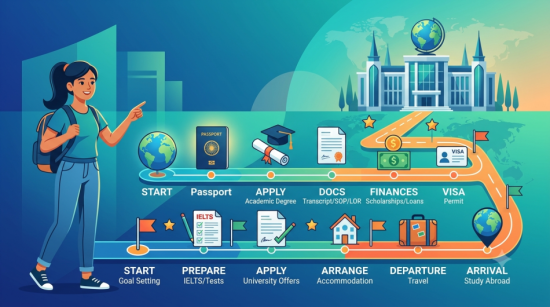
Planning to study abroad can be exciting, but the application process itself often feels confusing at first. There are courses to compare, universities to shortlist, tests to prepare for, documents to collect, deadlines to track and finally, visa formalities to complete.
The good news is that the study abroad application process becomes much easier when you understand the sequence clearly.
Instead of treating university applications, scholarships, English proficiency tests and visas as separate tasks, it helps to look at them as parts of one connected plan. Each stage affects the next. Choosing the right course influences your university shortlist. Your university requirements determine which tests you may need. Your admission offer then becomes important for the student visa stage.
If you are an Indian student planning higher education overseas, this guide explains the complete process from initial planning to departure, along with the common mistakes you should avoid.
Step 1: Start With Your Academic and Career Goals
A successful study abroad application should begin with one simple question: What are you hoping to achieve through this course?
Students sometimes begin by selecting a country simply because it is popular, or because friends and relatives are already studying there. That may not always lead to the right decision.
Before shortlisting universities, consider:
- Your current academic background
- Subjects you genuinely want to study
- Career opportunities related to the course
- Whether you are applying for undergraduate, postgraduate or research studies
- Your financial capacity
- Your preferred countries
- Your long-term professional plans
For example, a student interested in artificial intelligence may evaluate universities differently from someone planning a master’s in finance or public health.
Your destination should follow your academic plan, not the other way around.
Step 2: Research Countries Based on Your Requirements
The next stage of the study abroad application process is deciding which countries make sense for your goals.
Indian students commonly consider destinations such as:
- United States
- United Kingdom
- Canada
- Australia
- New Zealand
- Ireland
- Germany
- Other European countries
Each destination has its own education system, admission structure, tuition costs, visa rules and post-study opportunities.
Instead of asking only, “Which is the best country to study abroad?”, compare destinations using practical questions.
What does the course cost? What are the living expenses? Is the qualification well recognised in your industry? What are the admission requirements? Does the course offer internships, placements or research opportunities? What student visa conditions apply?
These factors provide a much stronger basis for choosing a destination than university rankings alone.
Step 3: Shortlist the Right Course and Universities
Once you have selected one or more suitable destinations, begin researching universities.
This stage requires more attention than simply choosing famous institutions.
Your university shortlist should consider:
- Course curriculum
- Entry requirements
- Faculty and research areas
- University reputation
- Accreditation where relevant
- Tuition fee
- Location
- Internship or industry opportunities
- Scholarships
- Application deadlines
- Graduate outcomes
Ideally, students should create a balanced shortlist.
You may include some ambitious universities where admission is highly competitive, universities that closely match your profile, and a few realistic alternatives.
Applying only to extremely selective institutions can unnecessarily increase the risk of ending up without an offer.
Step 4: Check Entry Requirements Before Applying
Every university and even every course within the same university can have different eligibility requirements.
Before investing time and application fees, verify whether your profile meets the basic criteria.
Common requirements can include:
- Class 10 and 12 marks
- Undergraduate degree percentage or GPA
- Relevant prerequisite subjects
- Work experience
- Portfolio for design or creative programs
- English proficiency scores
- GRE, GMAT, SAT or other tests where required
- Research proposal for some postgraduate or doctoral programs
Do not rely on a general statement such as “this country requires IELTS 6.5.” Universities set their own admission criteria, and visa requirements can be separate.
Always check the exact course page and official university information.
Step 5: Prepare for IELTS, TOEFL, PTE or Other Required Tests
English-language proficiency is an important part of many international applications.
Depending on the university, you may be asked to submit scores from tests such as:
- IELTS
- TOEFL
- PTE Academic
Some institutions may accept additional alternatives or provide exemptions under specific circumstances.
Students should first identify which tests their shortlisted universities accept before registering.
If an entrance examination such as GRE, GMAT or SAT is required or recommended, factor preparation time into your application timeline as well.
A common mistake is waiting until the university deadline is close before taking the test. This leaves little time for retesting if your score does not meet the requirement.
Preparing early gives you more flexibility.
Step 6: Collect Your Academic and Personal Documents
Documentation is one of the most time-consuming parts of the study abroad application process, particularly when universities require official transcripts or certified documents.
Depending on your level of study, you may need:
- Valid passport
- Class 10 and 12 certificates
- Bachelor’s or master’s degree certificate
- Semester-wise mark sheets
- Official academic transcripts
- English proficiency test results
- Standardized test scores
- CV or resume
- Portfolio, if applicable
- Work experience certificates
- Internship records
Universities may have their own specifications for document submission, so do not assume one format will work for every application.
Keep high-quality digital copies properly organised and ensure that your name and personal details are consistent across documents.
Step 7: Write Your Statement of Purpose Carefully
For many postgraduate and international university applications, the Statement of Purpose, or SOP, is one of the most important parts of the application.
A strong SOP should explain:
- Your academic background
- Why you chose the particular subject
- Relevant projects or experience
- Why the specific program interests you
- How the course connects with your career goals
Your SOP should sound like you.
Copying sample SOPs from the internet or using generic statements such as “I have always dreamed of studying at a prestigious university” does little to help an admissions committee understand your profile.
Instead, provide specific examples and a logical academic story.
Your marks show what you have achieved. Your SOP should help explain why the course is the right next step.
Step 8: Arrange Letters of Recommendation
Many universities, particularly for postgraduate programs, require one or more Letters of Recommendation, or LORs.
Recommendations may come from:
- Professors
- Academic supervisors
- Employers
- Managers
- Research mentors
Choose recommenders who genuinely know your academic or professional work.
A detailed recommendation from someone who has worked closely with you is often more meaningful than a vague letter from a senior person who barely knows your achievements.
Request recommendations early. Professors and managers may need time to prepare them, and some universities require recommenders to upload letters directly through an application portal.
Step 9: Submit University Applications Before the Deadline
Once your documents are ready, carefully complete each university application.
Check:
- Personal details
- Academic information
- Course selection
- Uploaded documents
- Test scores
- SOP
- Recommendation status
- Application fee, if applicable
Do not submit applications in a hurry.
Even small inconsistencies between your application form, passport and academic documents can create unnecessary questions.
Also remember that universities may have different deadlines for:
- General admission
- Scholarships
- Priority consideration
- Specific courses
Scholarship deadlines can sometimes be earlier than regular admission deadlines, so research both from the beginning.
Step 10: Track Your Application and Respond to Universities
Submitting the application is not the end of the process.
Universities may contact you asking for:
- Additional transcripts
- Updated test scores
- Clarification about your academics
- Portfolio or writing samples
- Interview
- Financial documents
Check your email and university application portals regularly.
Respond to requests promptly and only provide genuine information.
Depending on the university and program, you may receive an unconditional offer or an offer subject to certain conditions, such as completing your degree or meeting an English-language score.
Understand those conditions carefully before accepting.
Step 11: Compare Your University Offers Before Accepting
Receiving an offer is exciting, but do not immediately accept the first one.
Compare the complete picture.
Ask yourself:
- Which curriculum is strongest for my goals?
- What is the total tuition cost?
- Have I received a scholarship?
- What are the living expenses in that city?
- Does the course include internships or placements?
- What are the career outcomes?
- What conditions are attached to the offer?
Rankings can be useful, but they should not be your only criterion.
A slightly lower-ranked university with a stronger course, better industry exposure or substantially better financial support may be the better choice for your career.
Step 12: Apply for Scholarships and Plan Your Finances
Financial planning should happen throughout the application process, not after admission.
Depending on the country and institution, students may explore:
- Merit scholarships
- Need-based assistance
- University awards
- Government scholarships
- Research assistantships
- Teaching assistantships
- Education loans
Never assume that receiving university admission automatically means you will receive a scholarship.
Scholarship selection is often competitive and may involve separate criteria, essays or deadlines.
Calculate your likely total expenses realistically, including tuition, accommodation, food, transport, insurance, visa costs and travel.
Step 13: Move From University Admission to Student Visa Preparation
Once you accept the appropriate offer, the next major stage is your student visa or study permit application.
This is where students need to distinguish between university admission requirements and immigration requirements.
They are not the same.
For example, the UK requires students applying through the Student visa route to have an offer from a licensed sponsor and a Confirmation of Acceptance for Studies, or CAS, before applying. Applicants must also meet applicable financial and English-language requirements.
Canada generally requires a study permit applicant to provide a letter of acceptance from a Designated Learning Institution, proof of funds and, in most cases, a provincial or territorial attestation letter. The Canadian government also states that study permit applications are generally submitted online.
These examples demonstrate why students should always check the latest official immigration website for their chosen destination before applying.
Step 14: Prepare Visa Documents Carefully
Exact student visa documentation varies by country and personal circumstances.
Common categories of evidence may include:
- Valid passport
- University admission or enrolment documentation
- Financial evidence
- Tuition payment records
- English-language evidence, if required
- Academic documents
- Medical examination, where applicable
- Biometrics
- Additional country-specific forms or certificates
For UK Student visa applicants, GOV.UK lists a valid passport and CAS among the core documents, with additional evidence potentially required depending on circumstances.
For Canada, Immigration, Refugees and Citizenship Canada states that applicants must show proof of funds and may also need medical or police documentation depending on their circumstances.
Visa documentation should never be fabricated, altered or exaggerated. Immigration authorities may verify information, and misrepresentation can have serious consequences.
Step 15: Complete Biometrics, Medicals or Interviews if Required
Depending on the destination and your profile, your visa process may involve additional steps.
These may include:
- Biometrics
- Medical examination
- Visa interview
- Identity verification
- Additional document requests
For example, Canada’s immigration authorities instruct applicants who receive a biometrics request to complete it promptly, and incomplete applications may be returned or delayed.
Students should follow the instructions issued specifically for their application rather than relying on another applicant’s experience.
Step 16: Prepare for Departure Only After the Required Approval
Once your visa or immigration permission is approved, begin final travel preparation.
This stage may include:
- Booking accommodation
- Purchasing flights
- Arranging foreign currency or banking
- Organising health insurance
- Preparing original documents
- Understanding university orientation dates
- Learning about local transport
- Reviewing student visa conditions
Keep important documents in your hand luggage while travelling.
Do not pack essential immigration or university paperwork in checked baggage.
How Long Does the Study Abroad Application Process Take?
There is no universal timeline.
For many students, planning 9 to 12 months before the intended intake is sensible because it gives enough time for:
- Research
- Test preparation
- University applications
- Scholarships
- Offer decisions
- Visa processing
- Travel arrangements
Highly competitive universities, research programs and scholarship applications may require even earlier planning.
Students applying late may still find options, but their university and scholarship choices can become more limited.
Common Study Abroad Application Mistakes to Avoid
A strong application is not necessarily complicated. Most problems arise when students rush the process or rely on assumptions.
Some common mistakes include:
- Selecting a course only because it is popular
- Applying without checking entry requirements
- Using the same generic SOP everywhere
- Missing scholarship deadlines
- Submitting inconsistent information
- Leaving English tests until the last minute
- Underestimating tuition and living expenses
- Treating admission and visa requirements as identical
- Depending on outdated social media advice
- Choosing universities only because an agent recommends them
The most reliable approach is to verify important information through official university and government websites.
How Mindmine Global Supports the Study Abroad Application Process
For students and parents, managing all these steps independently can sometimes feel overwhelming.
Mindmine Global, Janakpuri, Delhi, provides guidance across different stages of overseas education planning, including:
- Student profile assessment
- Career and course counselling
- Country and university shortlisting
- IELTS, TOEFL and PTE preparation
- Application documentation guidance
- SOP and LOR support
- Scholarship guidance
- Study visa assistance
- Pre-departure counselling
The purpose of professional counselling should not be to push every student towards the same destination. Good guidance should help you understand your options, evaluate them realistically and make decisions that suit your academic background, budget and career ambitions.
FAQs About the Study Abroad Application Process
Q1: When should Indian students start applying to study abroad?
Starting approximately 9 to 12 months before the intended intake is a useful general approach. Some universities, scholarships and competitive programs require earlier preparation, so always check individual deadlines.
Q2: Can I apply to more than one country?
Yes. Students can apply to universities in multiple countries if they meet the relevant requirements. However, applications should be planned carefully because admission criteria, costs and visa processes differ.
Q3: Is IELTS compulsory for every study abroad application?
No. The English-language evidence accepted depends on the university, program and sometimes visa rules. IELTS, TOEFL and PTE are commonly accepted, while some institutions may provide other approved options.
Q4: Do I need a scholarship before applying to a university?
Not necessarily. Some scholarships are considered automatically with the university application, while others require separate applications. Always check the scholarship’s official eligibility and deadline.
Q5: Is a university offer enough to get a student visa?
No. University admission and immigration approval are separate processes. Receiving an offer does not guarantee a student visa. Applicants must also satisfy the destination country’s immigration requirements.
Q6: Can a study abroad consultant guarantee admission or visa approval?
No genuine consultant can guarantee a university admission or visa decision. Universities make admission decisions, while immigration authorities decide visa applications. Consultants can help students prepare stronger, accurate and properly organised applications.
Final Thoughts
The study abroad application process is easier to manage when you approach it in the right order.
Start with your academic and career goals. Research suitable countries and courses. Shortlist universities carefully. Prepare tests and documents early. Submit thoughtful applications. Compare offers based on more than rankings. Plan your finances realistically, and treat the visa stage as a separate process that requires its own careful preparation.
Most importantly, use current and reliable information. University requirements and immigration policies can change, so official sources should always be your final reference before making an important decision.
If you are planning international education and are unsure where to begin, Mindmine Global can help you create a structured application roadmap based on your academic profile, preferred destination and future goals.
Read Also This Blog