
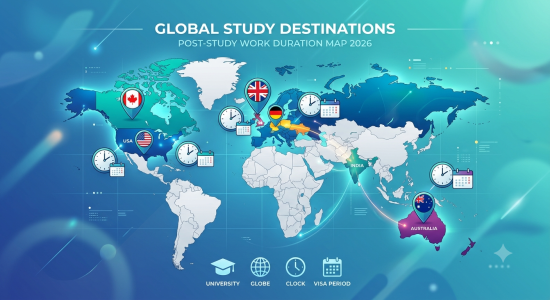
For many Indian students, choosing where to study abroad is not only about university rankings or course fees. An equally important question is:
What happens after graduation?
International education is a major financial and career investment. Naturally, students want to know whether their chosen destination will give them enough time after graduation to find a job, gain international work experience and potentially move towards a longer-term skilled work visa.
This is why post study work visa countries have become an important consideration for Indian students and parents.
Countries such as the UK, Canada, Australia, New Zealand, the USA, Ireland and Germany offer different pathways that may allow eligible international graduates to remain and work after completing their studies. However, the rules vary significantly. The duration, eligibility requirements, permitted work and options available after the graduate visa can differ from one country to another.
Here is a practical 2026 comparison to help students understand their options.
What Is a Post Study Work Visa?
A post-study work visa, graduate visa or similar immigration permission allows eligible international students to remain in the country where they studied after completing an approved qualification.
Depending on the country, graduates may use this period to:
- Find employment
- Gain professional experience
- Work in their area of study
- Build international experience
- Qualify for another skilled work visa
- Explore eligible long-term immigration pathways
One important point students should understand is that a post-study work visa is not the same as permanent residency.
It gives you temporary permission to remain and work under specific conditions. Whether you can stay longer depends on factors such as employment, occupation, salary, skills, immigration rules and the visa category available afterward.
Best Post Study Work Visa Countries for Indian Students in 2026
There is no single country offering the “best” post-study work visa for every student.
A three-year work period may look attractive, but it means little if your course has weak employment prospects. Similarly, a shorter graduate visa can still be valuable if your field has strong recruitment opportunities.
Students should therefore compare the visa alongside the course, job market and long-term career pathway.
1. United Kingdom: Graduate Visa
The UK’s Graduate visa allows eligible international students who successfully complete an approved course in the UK to remain after their studies and work or look for work.
For applications made on or before 31 December 2026, the Graduate visa lasts for 2 years for most eligible graduates. However, an important policy change is already confirmed. Applications made from 1 January 2027 onward will generally receive 18 months, while graduates with a PhD or other doctoral qualification can continue to receive 3 years.
This date matters enormously for students planning their intake.
A student beginning a course in 2026 should not automatically assume that a two-year Graduate visa will still apply by the time they finish. The applicable rule depends on when the graduate visa application is eventually submitted.
Why Students Consider the UK
The UK remains attractive because it offers:
- Globally recognised universities
- Many one-year master’s programs
- Access to a large professional job market
- The ability to work across different roles during the Graduate visa period
- Potential transition to another immigration category, such as the Skilled Worker route, if eligibility requirements are met
The Graduate visa itself cannot normally be extended. Students wishing to remain longer must qualify for another appropriate visa.
For this reason, students should think about employability before selecting their course, not only after graduation.
2. Canada: Post-Graduation Work Permit
Canada’s Post-Graduation Work Permit, or PGWP, allows graduates of eligible programs at eligible designated learning institutions to obtain Canadian work experience.
But Canada is one country where students need to be particularly careful about outdated information.
Simply studying at a Designated Learning Institution does not automatically guarantee PGWP eligibility. Students must check whether their particular institution and program meet the current requirements.
Canada has also introduced additional PGWP requirements in recent years, including language requirements for many applicants and field-of-study requirements for certain programs depending on when the study permit was applied for.
How Long Can a Canadian PGWP Last?
Under current rules:
- Certain eligible master’s graduates can receive a 3-year PGWP, even when the master’s program was shorter than two years, provided the program meets the applicable minimum duration and other eligibility requirements.
- For many other programs lasting between eight months and less than two years, the PGWP may be issued for approximately the same duration as the program.
- Eligible programs of two years or longer may result in a PGWP of up to 3 years.
Graduates generally have up to 180 days after completing their studies to apply for a PGWP, provided they meet the applicable requirements.
Is Canada Still a Good Post-Study Option?
It can be, but students should no longer choose a Canadian course simply because someone tells them it will automatically provide a three-year work permit.
Before paying tuition fees, verify:
- Is the institution a DLI?
- Is the particular program PGWP eligible?
- Do field-of-study requirements apply?
- What language requirement will apply?
- How long could the PGWP realistically be for that qualification?
Canada itself advises prospective students to check PGWP eligibility before submitting their study permit application.
That makes early course selection critical.
3. Australia: Temporary Graduate Visa
Australia offers post-study opportunities primarily through the Temporary Graduate visa, subclass 485.
For degree-level graduates, the Post-Higher Education Work stream generally allows eligible applicants to live, work and study temporarily in Australia after graduation.
Current official guidance states that this stream usually provides a stay of between 2 and 3 years depending on the qualification. Applicants generally must also be aged 35 or younger when applying, although specific exceptions apply, including for certain master’s by research and doctoral graduates.
Australia also has a Post-Vocational Education Work stream for certain eligible graduates with vocational qualifications related to occupations Australia requires.
Regional Study Can Matter
Eligible graduates who studied and subsequently lived in designated regional areas may qualify for a Second Post-Higher Education Work stream, which can provide an additional 1 or 2 years, depending on the regional location and other eligibility conditions.
This is why location can become an important part of Australian study planning.
However, students should not select a regional institution solely because they expect an immigration advantage. Course quality, employment opportunities, costs and eligibility should all be evaluated together.
4. New Zealand: Post Study Work Visa
New Zealand offers an official Post Study Work Visa that can allow eligible international graduates to remain and work for up to 3 years, depending on the qualification completed.
For degree-level 7 or higher qualifications, eligible graduates can generally work in any legal job in New Zealand.
For certain non-degree qualifications at level 7 or below, eligibility is more restricted. The qualification must be on the approved list and employment generally needs to relate to what the student studied.
Master’s and doctoral graduates who meet the required New Zealand study conditions may receive a three-year Post Study Work Visa.
An Important Change Coming in November 2026
New Zealand has announced further changes beginning 16 November 2026.
Post Study Work Visa eligibility will expand for certain students completing an NZQCF Level 7 Graduate Diploma where they also hold a bachelor’s degree.
New Zealand is also introducing a separate six-month Short-term Graduate Work Visa for some graduates who do not qualify for the standard Post Study Work Visa.
This is a good example of why students planning for 2026 or 2027 should always check immigration rules for the date when they are expected to graduate, rather than relying only on the rules existing when they begin researching universities.
5. USA: Optional Practical Training
The United States does not use the term “post-study work visa” in the same way as the UK or New Zealand.
Instead, eligible F-1 students may apply for Optional Practical Training, or OPT, which provides temporary employment authorization directly related to the student’s major field of study.
Eligible students can generally receive up to 12 months of OPT at a particular educational level.
STEM Graduates Can Potentially Work Longer
Certain graduates with qualifying degrees in Science, Technology, Engineering and Mathematics may be eligible for an additional 24-month STEM OPT extension.
This means eligible STEM graduates can potentially have up to 36 months of practical training authorization when the initial OPT and STEM extension are combined, subject to all applicable requirements.
However, OPT is not simply an unrestricted open work period.
Employment must be related to the student’s field of study, and additional rules apply. STEM OPT also has specific employer and reporting requirements.
For Indian students particularly interested in technology, engineering, data science, computer science or other eligible STEM programs, this can make the USA an attractive option. But students should evaluate the entire immigration and employment pathway instead of viewing OPT as a guarantee of long-term residence.
6. Ireland: Third Level Graduate Programme
Ireland has become increasingly attractive to international students, particularly those considering careers in technology, pharmaceuticals, finance, data and business.
Under Ireland’s Third Level Graduate Programme, eligible non-EEA graduates can remain in Ireland after completing certain recognised qualifications.
Graduates holding an eligible Level 8 award can generally receive 12 months of graduate permission.
Graduates with a Level 9 qualification or above may receive an initial 12 months, with the possibility of a further 12 months where they meet the required conditions, giving them up to 24 months under the program.
The purpose of this period is to allow graduates to seek suitable graduate-level employment and potentially move into an appropriate employment permit category.
For students considering Ireland, the qualification level therefore matters significantly when evaluating post-study opportunities.
7. Germany: Up to 18 Months to Find Qualified Employment
Germany follows another model.
International students from non-EU countries who successfully graduate from a German university may obtain a residence permit for up to 18 months to search for qualified employment.
During this period, graduates are permitted to take up any type of employment while looking for a suitable qualified position.
The official German portal states that applicants generally need to demonstrate:
- Successful completion of studies
- Health insurance coverage
- Ability to support themselves financially
The 18-month job-search residence permit is not renewable.
Germany can be particularly attractive for students considering engineering, manufacturing, technology, research and other skilled fields, but students should also think realistically about language.
Many university courses are available in English, but German-language ability can substantially expand employment possibilities in several industries.
Quick Comparison of Post Study Work Visa Countries
| Country | Typical Post-Study Opportunity in 2026 | Important Consideration |
| UK | 2 years for applications made by 31 Dec 2026, 18 months from 1 Jan 2027; 3 years for doctoral graduates | Graduate visa duration is changing |
| Canada | Up to 3 years depending on program and qualification | Program must meet current PGWP eligibility rules |
| Australia | Usually 2 to 3 years for eligible degree graduates | Qualification, age and regional conditions matter |
| New Zealand | Up to 3 years | Duration and work conditions depend on qualification |
| USA | Up to 12 months OPT, plus possible 24-month STEM extension | Employment must relate to field of study |
| Ireland | 12 months for eligible Level 8, potentially up to 24 months for Level 9+ | Intended for finding graduate-level employment |
| Germany | Up to 18 months job-search residence permit | Graduates search for qualified employment |
This comparison should be treated as a starting point rather than a final eligibility assessment. Individual circumstances and immigration rules can change.
Which Country Has the Best Post Study Work Visa?
Students often expect one clear winner, but this is the wrong way to compare destinations.
Suppose one country offers three years of post-study work but has limited opportunities in your particular profession. Another provides 18 months, but graduates from your field are actively recruited.
The second option could easily be better.
Instead, compare five things:
1. Your Course
Does your chosen qualification actually qualify for the graduate work pathway?
This is particularly important in countries such as Canada and New Zealand.
2. Graduate Employment Opportunities
Research the employment market in your specific sector, not the country’s overall employment reputation.
3. Length of Work Permission
More time can provide greater flexibility, but duration alone should never determine your university choice.
4. Conditions Attached to Employment
Some post-study permissions allow broad work rights, while others require employment to relate directly to your degree.
5. Your Route After the Graduate Period
Ask what happens after the post-study period expires.
Could you potentially transition to an employer-sponsored, skilled worker or another eligible visa?
A post-study visa should be viewed as a bridge into your early career, not as an automatic settlement route.
Mistakes Indian Students Should Avoid
One of the biggest mistakes students make is choosing a course based entirely on an expected work visa.
Avoid assumptions such as:
- “Every Canadian college gives a three-year PGWP.”
- “A UK master’s automatically gives me two years after graduation.”
- “Studying a STEM subject automatically guarantees three years of work in America.”
- “Post-study work means I will definitely receive PR.”
None of these statements accurately captures how the systems work.
Your eligibility depends on the exact immigration rules, institution, course, qualification and individual circumstances.
And policies change.
The UK’s confirmed Graduate visa change from two years to 18 months from January 2027 and New Zealand’s announced November 2026 changes demonstrate how quickly planning assumptions can become outdated.
How Should Indian Students Plan for Post-Study Work?
The right time to investigate post-study work eligibility is before accepting a university offer.
When shortlisting a program, check:
- Whether the university and course are recognised for the relevant graduate work route.
- How long your expected permission could be.
- Whether your course qualifies for any additional benefits.
- What employment restrictions apply.
- Whether your profession has realistic employment opportunities in that country.
- What visa options may exist after the graduate period.
- Whether the rules are already scheduled to change before you graduate.
Official government immigration websites should always be the final source for visa rules.
A blog, consultant, YouTube video or social media post can help explain a policy, but it should never replace the official eligibility criteria.
How Mindmine Global Helps Students Choose the Right Study Destination
Selecting a country purely because it advertises attractive post-study opportunities can lead to expensive mistakes.
At Mindmine Global, Janakpuri, Delhi, counselling considers the complete student profile, including academic background, preferred course, budget, university options and long-term career plans.
Students can receive support for:
- Country and course selection
- University shortlisting
- IELTS, TOEFL and PTE preparation
- Application documentation
- Scholarship guidance
- Study visa assistance
- Pre-departure planning
For post-study planning, the objective should be to understand the opportunity realistically, not to promise immigration outcomes that no education consultant can guarantee.
FAQs About Post Study Work Visa Countries
Q1: Which country gives the longest post-study work visa?
Several countries may offer eligible graduates up to three years under particular circumstances, including Canada, Australia and New Zealand. Eligible US STEM graduates may potentially receive up to 36 months through OPT plus a STEM OPT extension. The exact entitlement depends on qualification and eligibility requirements.
Q2: Does the UK still offer a 2-year post-study work visa?
Yes, but there is an important date change. Graduate visa applications made on or before 31 December 2026 can receive two years for eligible non-doctoral graduates. Applications made from 1 January 2027 generally receive 18 months. Doctoral graduates can receive three years.
Q3: Does every course in Canada qualify for a PGWP?
No. Graduating from a DLI alone does not automatically guarantee PGWP eligibility. Students need to check the specific institution, program and current eligibility conditions before enrolling.
Q4: Which country is best for Indian students who want to work after studying?
There is no universal best option. The answer depends on your field of study, qualification, budget, employment prospects and long-term career plans.
Q5: Does a post-study work visa guarantee permanent residency?
No. A post-study work visa is temporary. Work experience gained during this period may help with certain future immigration routes in some countries, but permanent residency has separate eligibility requirements.
Q6: Should I choose a country based mainly on its post-study work visa?
No. Post-study work rights should be one factor alongside university quality, course relevance, tuition cost, living expenses, employment prospects and your broader career objectives.
Final Thoughts
For Indian students planning international education in 2026, post study work visa countries offer valuable opportunities to gain professional experience after graduation. The UK, Canada, Australia, New Zealand, USA, Ireland and Germany all provide potential graduate work pathways, but they operate very differently.
The smartest approach is not to ask which country offers the longest visa.
Ask instead:
Which country gives me the strongest combination of education, employability, affordability and realistic post-study opportunities for my specific career?
That question leads to much better study abroad decisions.
Because immigration policies can change, students should verify the latest eligibility rules through official government sources before paying deposits or making decisions based on expected post-study work rights.
If you need help comparing countries based on your course, academic profile and career plans, Mindmine Global can provide structured study abroad counselling and help you evaluate your options with greater clarity.
Read Also This Blog