
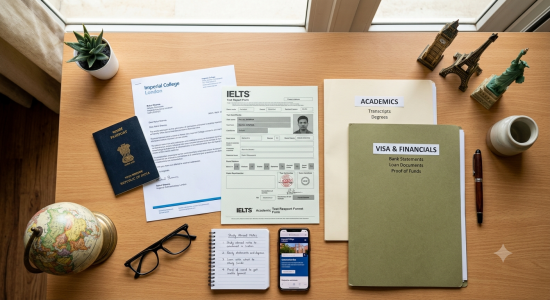
Planning to study overseas involves much more than choosing a country and university. Once you start applying, documentation becomes one of the most important parts of the process, and it is often the part students underestimate the most. A missing transcript, an outdated passport, unclear financial records, or incorrect visa documentation can delay an otherwise strong application. Even a well-qualified student with excellent grades can face rejection or delay simply because a document was submitted in the wrong format, was not attested correctly, or was missing altogether. If you are an Indian student preparing for international education, knowing the documents required to study abroad early can save considerable time, money and last-minute stress.
There is no single document checklist that applies to every country or university. Requirements depend on your destination, course, level of study, institution and visa category. A student applying to a UK master’s program will not need the exact same paperwork as someone applying for an undergraduate degree in Canada or Australia. However, most applications, regardless of destination, involve the following core documents.
1. Academic Documents
Your academic records help universities determine whether you meet their entry requirements. Depending on whether you are applying after Class 12 or for postgraduate studies, you may need:
- Class 10 and Class 12 mark sheets and certificates
- Bachelor’s degree and semester-wise transcripts for postgraduate applications
- Provisional or final degree certificate
- Academic transcripts issued by your institution
- Backlog certificate, if specifically requested
Universities may ask for official, certified or directly submitted transcripts, so always follow the individual institution’s instructions rather than sending the same format everywhere. Some universities require transcripts to be sent directly from your previous institution to theirs through a secure portal, while others accept scanned, self-attested copies at the application stage and verified originals only at enrolment. Mixing up these two processes is one of the most common reasons academic documentation gets delayed.
If your degree certificates or mark sheets are in a regional language, you may also need notarised English translations. Keep extra certified copies on hand, since many applications and visa steps will ask for the same documents more than once.
2. Valid Passport
A valid passport is one of the basic documents required throughout the study abroad process. Your name, date of birth and other personal details across your application documents should be consistent with your passport. Even small inconsistencies, such as a middle name appearing in one document and not another, can trigger additional scrutiny during visa processing.
Do not wait until the visa stage to check its validity. If your passport is close to expiry, review the destination country’s requirements before beginning applications, since some countries expect the passport to remain valid for a minimum period beyond your intended stay. If your passport needs renewal, start that process early, as it can take several weeks and should not be left until after you receive your admission offer.
3. English Language Test Scores
Depending on the university and program, you may need to demonstrate English proficiency through tests such as:
- IELTS
- TOEFL
- PTE Academic
- Duolingo English Test (accepted by a growing number of universities)
The required test and minimum score vary significantly by university and course. Some institutions may offer exemptions, for example based on your medium of instruction during previous studies, or accept other evidence, but students should confirm this directly through the university’s official admission requirements rather than assuming that an IELTS waiver applies. Test score validity also matters: most scores are valid for two years, so timing your test around your intended intake is important. If your first attempt does not meet the required band or score, factor in enough time for a retake before application deadlines close.
4. Statement of Purpose and Letters of Recommendation
For many international programs, especially postgraduate courses, your application is not evaluated on marks alone.
A Statement of Purpose (SOP) explains your academic background, reasons for selecting the course and how it relates to your future plans. A strong SOP connects your past experience, your reasons for choosing that specific university and program, and your future goals into a coherent narrative, rather than simply repeating your resume in paragraph form.
Universities may also request Letters of Recommendation (LORs) from teachers, professors or professional supervisors who can provide credible insight into your academic or professional abilities. It helps to approach recommenders well in advance and share your resume and target programs with them, so the letter can speak specifically to your strengths rather than reading as a generic reference.
Both should be genuine and specific. Generic or copied statements rarely represent a student’s profile effectively, and admissions committees who review thousands of applications each year can often identify templated content easily.
5. Resume or CV
A CV is commonly requested for master’s, MBA and other professional programs. It may include:
- Education
- Internships
- Employment experience
- Projects
- Certifications
- Research or publications
- Relevant extracurricular achievements
Keep it factual and relevant to the program you are applying for. A one- or two-page format is generally preferred, and it is worth tailoring the emphasis of your CV depending on whether you are applying to a research-focused program or a more industry-oriented one.
6. Proof of Admission
Once you receive admission, the institution provides formal evidence of enrolment or acceptance. The terminology differs by country.
For example, UK Student visa applicants need a Confirmation of Acceptance for Studies (CAS) from their licensed sponsor. Australia generally requires a Confirmation of Enrolment (CoE) for the Student visa. Canadian study permit applications require a letter of acceptance from a Designated Learning Institution, and many applicants also need a provincial or territorial attestation letter.
These are not interchangeable documents, so students should follow the exact requirements of their chosen country. Applying for a visa with the wrong type of admission letter, or before the correct one has been issued, is a common and avoidable source of delay.
7. Financial Documents for the Student Visa
Financial evidence is an important part of many student visa applications. Depending on your destination and circumstances, this can include:
- Bank statements
- Education loan documents
- Scholarship or sponsorship letters
- Tuition payment receipts
- Sponsor income documents
- Other acceptable evidence of available funds
For example, Canada currently requires applicants to demonstrate sufficient funds for tuition, living expenses and transportation. The amount and acceptable evidence can change, so students should check the latest official immigration requirements before applying. If you are funding your studies through a bank loan rather than personal savings, lenders will typically ask for admission letters, academic records and collateral or income documents before sanctioning the amount, so it helps to start this process as soon as you receive an offer rather than waiting until closer to your visa deadline.
8. Additional Visa Documents
Depending on your country and personal circumstances, you may also require medical examinations, biometrics, photographs, health insurance, parental consent for minors, police-related documentation or country-specific declarations.
This is exactly why copying a checklist from an old blog or social media post can be risky. Visa authorities can update requirements, and additional evidence may be requested depending on an applicant’s circumstances. Australia, for example, specifically advises applicants to use its official document checklist because required financial and English-language evidence can vary based on the applicant’s individual profile.
How to Keep Your Study Abroad Documents Organised
Start preparing documents several months before your target intake. Keep clear digital copies, use consistent file names and maintain separate folders for academic, financial, university and visa documents. This becomes especially useful when you are applying to multiple universities at once, since each may need the same set of documents formatted or arranged slightly differently.
Most importantly, never alter or manufacture documents to strengthen an application. Universities and immigration authorities can verify submitted information, and false documentation can have serious consequences.
A few recurring mistakes cause most avoidable delays: scanned documents that are hard to read, names or dates of birth that don’t match exactly across documents, missing notarisation where a country requires it, and applying for a visa before the correct admission or enrolment letter has actually been issued. Checking for these before submission is far easier than correcting them afterward.
How Mindmine Global Can Help
Managing applications becomes easier when documentation is planned from the beginning. Mindmine Global, Janakpuri, supports students with university and course selection, application documentation, IELTS, TOEFL and PTE preparation, scholarship guidance and study visa assistance.
The aim is not simply to collect documents, but to ensure that each part of the application accurately represents the student’s academic profile and future plans.
Frequently Asked Questions (FAQs)
Q1. Do all countries require the same documents?
Ans. No. University admission and student visa requirements vary by destination, institution, course and applicant profile.
Q2. Is IELTS compulsory for studying abroad?
Ans. Not always. Some universities accept other English proficiency tests, such as TOEFL, PTE, or the Duolingo English Test, or approved alternatives. Always check the specific university and visa requirements.
Q3. When should I start preparing my documents?
Ans. Ideally, begin collecting academic, passport and supporting documents well before applications open. SOPs, recommendations and financial preparation should not be left until the final deadline.
Q4. Do I need financial documents while applying to universities?
Ans. Some universities may request them, but financial evidence becomes particularly important during student visa applications. Requirements vary by destination.
Q5. What proof of admission do I need for my student visa?
Ans. This depends on the country: a CAS for the UK, a CoE for Australia, and a letter of acceptance (along with a provincial attestation letter in some cases) for Canada. Always use the exact document your destination country requires.
Conclusion
Preparing the documents required to study abroad may seem complicated at first, but a systematic approach makes the process much easier. Start early, follow official university and government requirements, and never rely on one generic checklist for every destination.
If you are unsure which documents apply to your chosen country, course or intake, Mindmine Global can help you build a clear study abroad application plan based on your individual profile.
Read Also This Blog